Blog
ERMS Editorial Team | 25 July 2026
How to Prepare for Placements from Day One of MBA
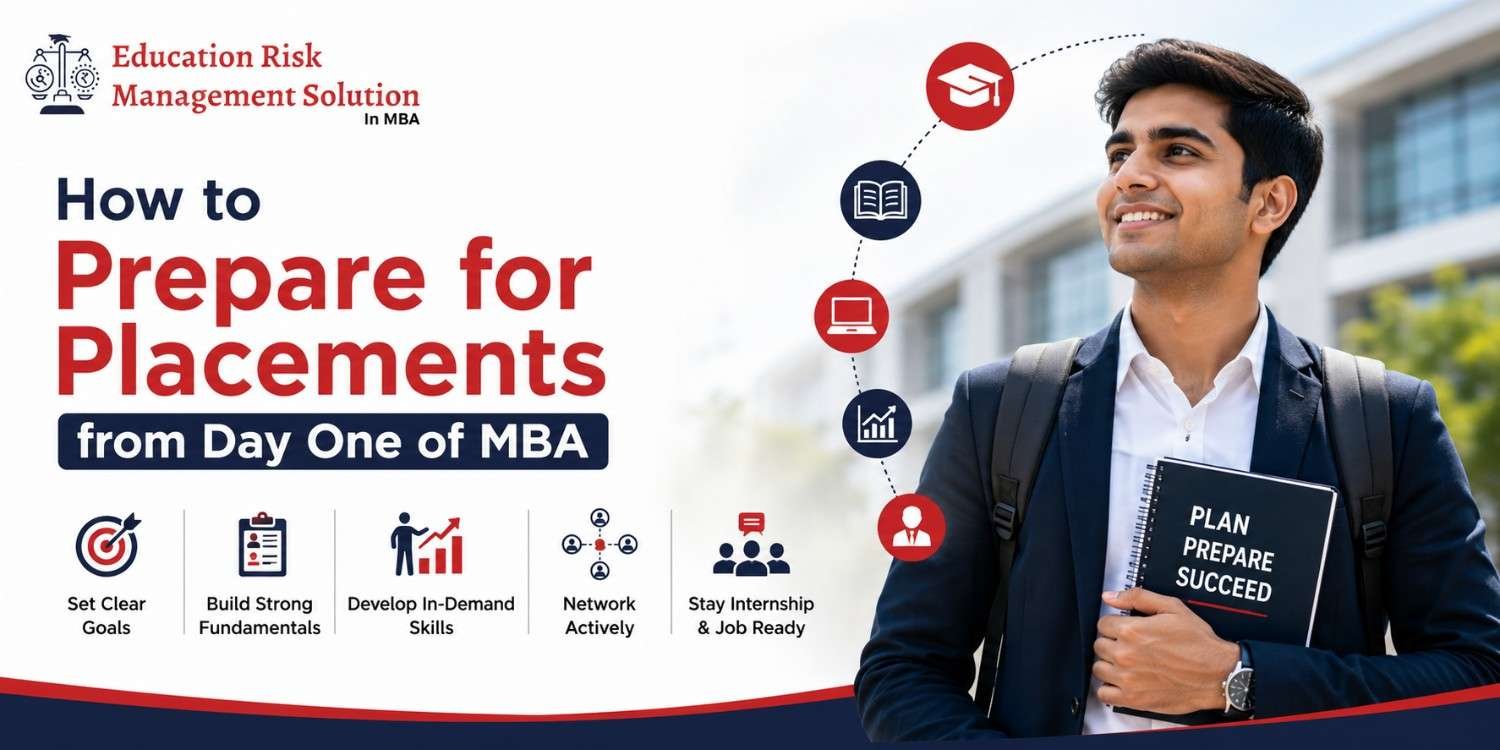
Table of Contents
Introduction
Getting into an MBA program feels like the finish line after months of entrance exams and interviews. But here’s the truth every successful placement topper will tell you MBA is not the finish line, it’s the starting block for placements. The students who land their dream offers in Day Zero or Day One companies are almost never the ones who start preparing in the final trimester. They’re the ones who treat orientation week as placement prep week one.
If you’re wondering how to prepare for placements from day one of MBA, this guide breaks it down month by month, skill by skill, so you walk into placement season with confidence instead of panic.
Why Day One Matters More Than You Think
Most MBA placement processes especially for consulting, product management, and investment banking roles are won or lost long before the actual interview date. Recruiters look for consistency, a strong CV built over two years, visible extracurricular involvement, internships that show progression, and academic performance that doesn’t dip. None of this can be manufactured in the last two months before placements begin.
Starting early gives you:
● More attempts to fail and improve (case interviews, group discussions, mock interviews).
● Time to build a genuine profile instead of a resume that looks assembled overnight.
● Reduced stress during placement season because the groundwork is already done.
● A competitive edge over peers who are still “figuring things out” in term three.
Month-by-Month MBA Placement Preparation Roadmap
Months 1-2: Orientation and Self-Assessment
Before you chase every club and competition, pause and figure out your direction.
● Identify 2–3 broad career interests (consulting, marketing, finance, operations, product management, Hospital & Healthcare Management, general management).
● Talk to seniors and alumni about day-to-day realities of these roles, not just the campus fest and upcoming events.
● Take stock of your existing skills quantitative ability, communication, leadership experience, technical know-how.
● During induction activities, take the initiative to lead. Even if your answer is wrong, be confident enough to speak up. Every mistake is an opportunity to learn and grow.
● Keep a placement journal or spreadsheet to track your progress, skills, and goals. It may feel like extra work now, but it will make your placement journey much easier.
Months 3-5: Foundation Building
This is when you build the base that recruiters will scrutinize later.
● Academics: Keep your grades consistent many companies apply CGPA cutoffs for shortlisting.
● Clubs and committees: Join at least one club aligned with your career interest (finance club, consulting club, marketing cell, placement cell) and take on real responsibility, not just a title.
● Reading habit: Follow business news daily The Economic Times, Mint, Harvard Business Review to build case-interview and GD-readiness.
● Excel and PowerPoint: Get comfortable with these tools early; they’re used in every internship and job.
Months 6-8: Skill Specialization
Once you’ve chosen a broad direction, go deep.
● For Consulting: Start practicing case interviews weekly with a peer group. Learn frameworks (but don’t over-rely on them) and structured problem-solving.
● For Finance: Build financial modeling skills, understand valuation basics, and follow markets closely.
● For Marketing: Work on brand case studies, consumer behavior projects, and live client problems if your college offers them.
● For Product/Tech roles: Learn the basics of SQL, product thinking frameworks, and analytics tools.
● For HHM (Hospital & Healthcare Management): Build a strong understanding of healthcare operations, hospital administration, healthcare regulations, and quality standards. Stay updated on healthcare trends and gain practical exposure through hospital projects or internships whenever possible.
This is also the stage to start applying for live projects, competitions, and case study challenges hosted by companies these often lead directly to summer internship interview calls.
Months 9-10: Summer Internship Preparation
The summer internship is your first real placement test. Most final placement offers
(PPOs) come from strong summer internship performance.
● Polish your resume with quantifiable achievements, not just responsibilities.
● Do at least 15-20 mock interviews with seniors, professors, or career services.
● Prepare your “tell me about yourself” pitch until it’s crisp and authentic.
● Research every company on your target list business model, recent news, competitors.
Months 11–14 The Summer Internship Itself
● Treat every task as a chance to prove you deserve a PPO.
● Build relationships with your manager and team visibility matters as much as output.
● Document your achievements weekly; you’ll need these for your final placement resume.
● Ask for feedback proactively instead of waiting for the final review.
Months 15–18: Final Placement Preparation
● Update your resume with internship outcomes and any new certifications or projects.
● Revisit case interviews, technical rounds, and GD practice with renewed intensity.
● Network with alumni working at your target companies informational interviews go a long way.
● Practice group discussions and personal interviews in mock settings at least twice a week.
Months 19–24 Final Placements and Beyond
● Stay updated on the latest company briefings and job descriptions.
● Customize your resume and pitch slightly for each company/role.
● Don’t get discouraged by early rejections placement season is a marathon, not a sprint.
● Support batchmates too; a healthy cohort atmosphere reduces everyone’s stress.
Core Skills to Build Throughout Your MBA
Regardless of your target role, these skills are non-negotiable for placement success:
1. Communication and storytelling the ability to structure and present ideas clearly.
2. Quantitative and analytical ability comfort with data, numbers, and business metrics.
3. Case-solving and structured thinking especially critical for consulting and product roles.
4. Networking genuine relationship-building with seniors, alumni, and recruiters.
5. Resume and LinkedIn optimization your first impression before you even speak.
6. Interview readiness mock interviews, behavioral questions, and situational judgment.
Common Mistakes MBA Students Make
● Waiting for placement season to start preparing by then, competition is fierce and time is short.
● Chasing every club and competition without direction spreading yourself thin dilutes your profile.
● Ignoring soft skills technical brilliance without communication skills rarely wins offers.
● Not networking early enough many roles are filled through referrals and informational interviews.
● Treating the summer internship casually it’s often your best shot at a Pre-Placement Offer (PPO).
Final Thoughts
Placement success in an MBA program is rarely about last-minute cramming; it’s about consistent, intentional effort from day one. Build your foundation early, specialize strategically, perform strongly in your internship, and stay disciplined through final placements. The students who follow a structured plan like this one consistently outperform those who wait until the last moment. Start today. Your placement season self will thank you.
Related Articles:
Latest Blogs
Read the latest blogs from TernaGBS to gain insights, trends, and tips for your career growth.