Blog
ERMS Editorial Team | 18 July 2026
Why Some ERMS Graduates Struggle Despite Having a Degree
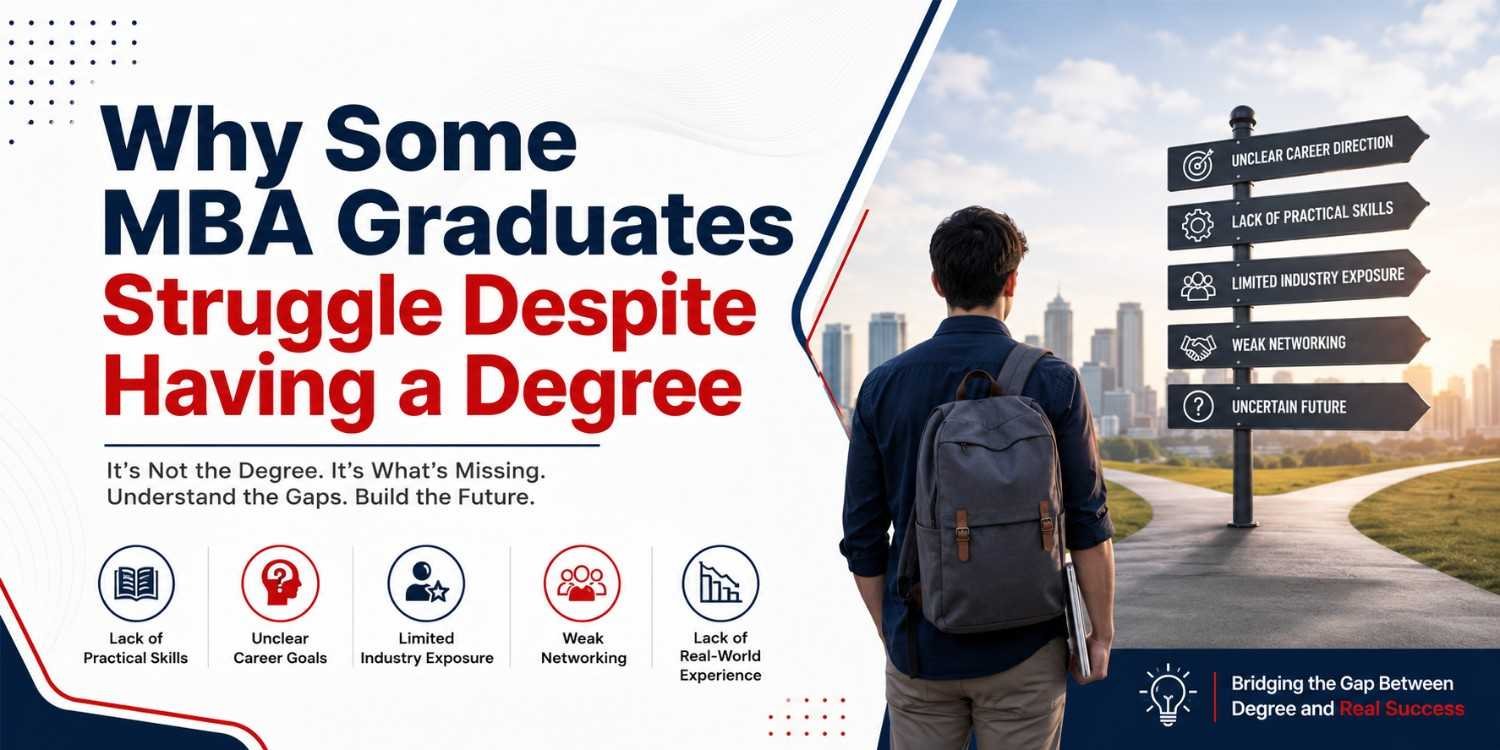
Table of Contents
- Introduction
- 1. The MBA Market Is More Crowded Than Ever
- 2. Choosing the Wrong College or Program
- 3. Lack of Real-World Experience
- 4. Weak Soft Skills and Communication
- 5. Unrealistic Salary and Role Expectations
- 6. Networking Is Ignored Until It’s Too Late
- 7. No Specialization or Unclear Career Direction
- 8. Ignoring Industry Trends and Skill Gaps
- 9. Poor Financial Planning Around the Degree
- How to Avoid Becoming a “Struggling MBA Graduate”
- Final Thoughts
- Related Articles
Introduction
Every year, 80% of students take education loans for MBA, sacrifice two years of income, and pour their savings into an MBA believing the degree alone will unlock a high-paying job and a fast-tracked career. Yet a growing number of MBA graduates find themselves underemployed, stuck in roles that don’t match their expectations, or struggling to even land interviews.
If you’re a student, an aspiring MBA candidate, or someone who already has the degree and feels stuck, this post breaks down why an MBA doesn’t automatically guarantee success and what actually separates graduates who thrive from those who struggle.
1. The MBA Market Is More Crowded Than Ever
A few decades ago, an MBA was a rare and powerful credential. Today, business schools around the world produce hundreds of thousands of graduates annually. When supply increases faster than demand for high-paying management roles, the degree alone stops being a differentiator.
What this means for you: Employers no longer hire “an MBA” they hire a person with an MBA plus demonstrable skills, experience, and results. The degree gets you past the resume filter, not necessarily the finish line.
2. Choosing the Wrong College or Program
Not all MBAs are created equal. A degree from a low-ranked, non-accredited, or purely “convenience-based” institute rarely carries the same weight as one from a recognized, industry-connected program.
Common mistakes students make:
● Picking a college based on low fees or easy admission instead of placement record.
● Ignoring faculty quality, industry tie-ups, and alumni network strength.
● Choosing a generic MBA instead of a specialization aligned with market demand.
Lesson: Research placement statistics, recruiter partnerships, and alumni outcomes before enrolling not after.
3. Lack of Real-World Experience
Many students go straight from undergraduate studies into an MBA without ever working. They graduate with strong theoretical knowledge, case studies, frameworks, financial models but little exposure to how business actually operates on the ground.
Recruiters increasingly value candidates who can:
● Apply frameworks to messy, real business problems.
● Communicate with cross-functional teams.
● Show ownership of outcomes, not just academic performance.
Without prior work experience or strong internships, graduates often struggle to translate classroom learning into workplace impact.
4. Weak Soft Skills and Communication
An MBA teaches strategy, finance, and operations but it doesn’t automatically build:
● Confident communication
● Negotiation and persuasion
● Emotional intelligence
● Leadership under pressure
Technical knowledge gets a graduate shortlisted; soft skills get them hired and promoted. Many struggling graduates are highly capable on paper but underperform in interviews, group discussions, and day-to-day workplace interactions.
5. Unrealistic Salary and Role Expectations
A significant number of MBA graduates struggle simply because they set expectations based on outlier success stories, the rare classmate who landed a seven-figure package at a top consulting firm rather than realistic market averages for their specialization and college tier.When expectations don’t match market reality, graduates either:
● Reject reasonable offers while waiting for a “dream role” that never comes, or
● Accept a role reluctantly and underperform due to resentment or lack of motivation.
6. Networking Is Ignored Until It's Too Late
Business schools are built around networking classmates, alumni, guest faculty, and industry events. Students who treat the MBA as “just classes and exams” miss the single biggest advantage the degree provides: relationships.
Graduates who struggle later often report:
● Never building relationships with alumni in target companies.
● Skipping industry events, seminars, and case competitions.
● Relying solely on the placement cell instead of proactive outreach.
7. No Specialization or Unclear Career Direction
Some students enter an MBA without a clear sense of what career path they want: marketing, finance, operations, HHM, consulting, product management and graduate just as confused. Recruiters can sense when a candidate hasn’t committed to a direction, and generalist resumes with no clear focus often get passed over for more targeted candidates.
8. Ignoring Industry Trends and Skill Gaps
The business world is shifting fast data analytics, digital marketing, AI-driven decision-making, and automation are reshaping almost every function. Graduates who rely purely on traditional MBA coursework, without upskilling in relevant tools and technologies, often find their knowledge outdated by the time they enter the job market.
9. Poor Financial Planning Around the Degree
An MBA is expensive, and student loans can create pressure that affects decision-making. Graduates burdened by high EMIs sometimes take the first available job instead of the right one, or feel forced into high-stress roles purely for the paycheck leading to early burnout and career dissatisfaction.
How to Avoid Becoming a "Struggling MBA Graduate"
If you’re currently pursuing or planning to pursue an MBA, here’s how to stay ahead:
1. Choose your college based on outcomes, not convenience verify placement data independently.
2. Get relevant work experience or internships before and during the program.
3. Actively build soft skills communication, leadership, and negotiation don’t develop passively.
4. Set realistic expectations based on your specialization and college tier, not exceptional outliers.
5. Network intentionally treat every class, event, and alumni interaction as a career investment.
6. Pick a specialization early and build a portfolio of relevant projects or certifications around it.
7. Keep learning beyond the syllabus analytics, digital tools, and industry-specific skills matter.
Final Thoughts
An MBA is a powerful tool but it’s a tool, not a guarantee. The graduates who struggle are rarely the ones who lack intelligence; they’re often the ones who treated the degree as the destination rather than the starting point. Success after an MBA comes down to the choices made around the degree: the college, the experience, the skills, the network, and the mindset.
If you’re a student planning your MBA journey, start today by asking not “Will this degree get me a job?” but “What am I doing, beyond the degree, to make myself the obvious hire?
Related Articles:
Latest Blogs
Read the latest blogs from TernaGBS to gain insights, trends, and tips for your career growth.